
Prevention
Modern medicine is increasingly transitioning towards preventive care. This shift towards prevention has also been observed in breast cancer care in recent years, particularly with the discovery of the BRCA gene. Subsequently, multiple genes and risk factors have been identified. Depending on these factors, a personalized screening strategy can be chosen. Therefore, it is crucial to understand these genetic and risk factors.
Diagnosis
I was diagnosed with cancer ... This website serves as a portal designed to assist you and your loved ones in accessing personal information and finding solutions to your concerns.
The primary goal of this website is to offer guidance and support to patients as they navigate their journey toward recovery and improved quality of life. The "Diagnosis" section of our website is divided into two main categories. Firstly, under "Anatomy and Physiology," we provide fundamental knowledge about the breast. Secondly, in the "Tumors and Disorders" section, we delve deeper into various breast-related conditions.
Moreover, we aim to provide information to women who may be concerned about potential breast issues but are hesitant to seek immediate medical advice. Knowledge and information can often offer immediate reassurance if a woman is able to identify the issue herself and determine that no specific treatment is necessary. Conversely, we also strive to educate women who have received a diagnosis of a serious breast condition, such as breast cancer, and wish to approach their doctor well-informed and prepared.
Treatment
The treatment for breast cancer should immediately include a discussion about reconstruction. Our foundation has no greater goal than to raise awareness of this among patients and oncological surgeons. By making an informed decision beforehand, we avoid closing off options for later reconstruction while still considering the oncological aspect. Of course, survival is paramount, and the decision of the oncologic surgeon will always take precedence.
The "Reconstruction or not?" page contains all the information you can expect during an initial consultation before undergoing tumor removal. This page is comprehensive, and your plastic surgeon will only provide information relevant to your situation.
"Removing the tumor" details the surgical procedure itself. This is the most crucial operation because effective tumor removal remains paramount. We guide you through the various methods of removal, a decision often made by a multidisciplinary team comprising oncologists, radiologists, pathologists, radiotherapists, breast nurses, gynecologists, oncological surgeons, and plastic surgeons.
The "Breast Reconstruction" section includes information and illustrations of the different reconstruction options along with corresponding steps.
Revalidation
Those treated for cancer often need a long period to recover.
Cancer is a radical illness with a heavy treatment. Often, people have to deal with psychosocial and/or physical problems afterwards, such as stress, anxiety, extreme fatigue, painful joints, reduced fitness, lymphedema... This can have a major impact on general well-being.
There are rehabilitation programmes offered by most hospitals. We cover some of the major topics here.
Quality of life
Quality of life is a key factor in coping with breast cancer. Therefore, it is important to find coping mechanisms that work, which will be different from patient to patient. For some, it may be finding enjoyment in activities they engaged in prior to diagnosis, taking time for appreciating life and expressing gratitude, volunteering, physical exercise... Of prime importance, studies have shown that accepting the disease as a part of one’s life is a key to effective coping, as well as focusing on mental strength to allow the patient to move on with life. In this section we are addressing some topics that patients experience during and after treatment and we are providing information to address them.
Genetic factors
Does breast cancer run in your family? Read what BRCA1 and BRCA2 mean, which preventive options exist and how genetic testing works.
Hereditary breast cancer: genetic factors and BRCA
Does breast cancer run in your family and are you wondering whether heredity plays a role? Not all breast cancer is hereditary. On this page you can read what breast cancer in the family means, what BRCA1 and BRCA2 are, which preventive options exist and how genetic testing works. An example from practice makes it concrete.
Breast cancer in the family: when is your risk increased?
Breast cancer in the family (a significant family history) is one of the strongest indications of an increased risk of breast cancer. The risk for other women in that family is greater the more women in the family have had breast cancer, the more closely related they are, and the younger they were when they were diagnosed.
It is estimated that 20 to 30% of all breast cancer patients have at least one relative with the same condition. In about 5 to 10% of all patients, there is a strong genetic predisposition.
The following elements determine how great the risk is that a woman will develop breast cancer herself:
how many relatives in her family have had breast or ovarian cancer;
how many women in the family are and are not affected (the ratio between the two);
how closely the affected family members are related to each other;
how old her relatives were when breast cancer was diagnosed;
whether a relative developed breast cancer in both breasts (bilateral breast cancer);
whether ovarian cancer occurs in the family;
whether breast cancer occurs in men.
Based on these elements, patients are assigned a strongly, moderately or slightly increased risk. Based on that risk, they are first and foremost given advice on the best way to be screened.
The family information also shows in which families genetic testing may be useful. You can read which criteria apply below. They are a guideline: sometimes testing is also started in families that do not meet the criteria, if there are specific reasons for this. For example, if the family tree is difficult to assess (because the family is small or because there are many male relatives), or if genetic testing has important consequences for the medical approach (clinical implications). Sometimes an exception is also made for patients with very high levels of anxiety, for whom a genetic test is almost vitally important.
When is genetic testing an option?
The Belgian centres for human genetics apply broad criteria. Some typical examples where genetic testing is an option:
breast cancer before the age of 40
triple-negative breast cancer (the age limit depends on the centre)
ovarian cancer, at any age
breast cancer in a man
breast cancer in both breasts (bilateral breast cancer)
a known mutation in the family
Testing is also done when the result changes the treatment (for example with PARP inhibitors). Ask your GP or a centre for human genetics whether testing is useful for you.
Familial and hereditary breast cancer: what is the difference?
Women with a strongly increased risk of breast cancer typically have several first-degree relatives who were diagnosed with breast cancer at a young age. Or they have one or more relatives with breast cancer in several places in the breast (multifocal) or in both breasts (bilateral). In addition, ovarian cancer (ovarian carcinoma) is often found in their family, and sometimes men in those families also develop breast cancer. In such families, the genetic predisposition is often the result of an inherited genetic abnormality, also called a mutation, in the BRCA1 or BRCA2 gene. These families usually meet the criteria for what we call hereditary breast and ovarian cancer syndrome.
Familial breast cancer and hereditary breast and ovarian cancer syndrome: the difference
Hereditary breast and ovarian cancer syndrome: breast and/or ovarian cancer | Familial breast cancer |
in at least three first-degree relatives (or, with paternal inheritance, second-degree relatives) | breast cancer in at least 2 first- or second-degree relatives, at a young age, without the conditions for the hereditary form being met |
In families in which the risk is moderately or slightly increased, the affected relatives are less closely related and are considerably older at diagnosis. We usually call such families families with familial breast cancer (see the table above). In a minority of these families, genetic abnormalities in BRCA1 or BRCA2 are also found. There are indications that other genetic 'variants' also play a role in these families. These are abnormalities in the genetic material that affect the risk of breast cancer less strongly than mutations in BRCA1 or BRCA2. These variants are probably much more common than BRCA1 or BRCA2 mutations and may therefore have a greater effect in the general population. In addition, there is a real chance that the impact of these variants is influenced by non-genetic factors. Today, gene panels are standard: in addition to BRCA1 and BRCA2, other genes are also tested (see below under genes other than BRCA).
The distinction between hereditary and familial breast cancer is not clear-cut. The contribution of genetic abnormalities is probably a kind of continuum (a sliding scale). In familial breast cancer, genetic abnormalities that affect the risk to a limited (modest) extent are more likely to be involved. In the monogenic forms, which are caused by a single gene, most families have BRCA1 or BRCA2 mutations that strongly affect the risk (see figure 1). Many families, however, are on the borderline between the two, and in a number of them we can demonstrate BRCA1 or BRCA2 mutations.
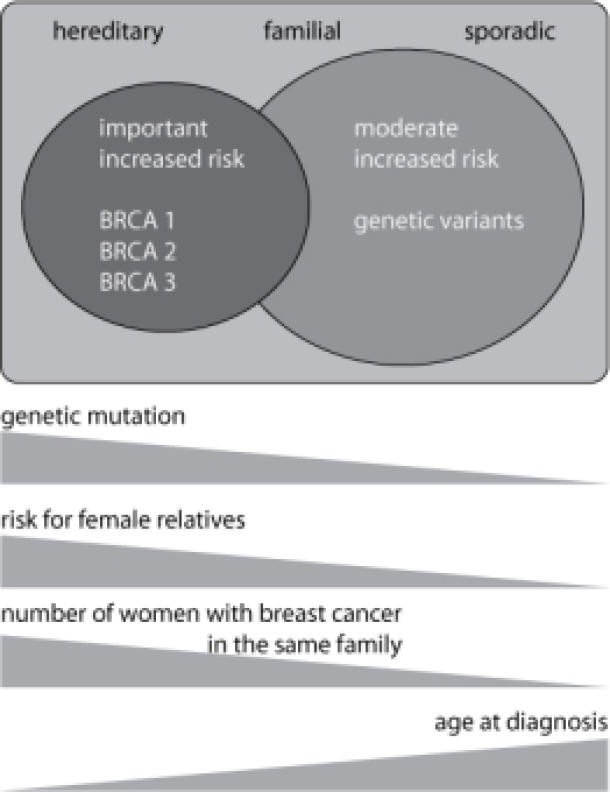
Figure 1. Based on breast cancer and family history, patients can be divided into three overlapping groups: the sporadic, the familial and the hereditary form. Genetic abnormalities (mutations in BRCA1 and BRCA2) are found most often in the hereditary form. They cause a strongly increased risk of breast and ovarian cancer in female carriers. In familial breast cancer, genetic variants that affect the risk less strongly probably play a role. The younger the age at diagnosis and the more affected relatives in a family, the greater the chance of a hereditary form. This also means that the risk for other women in the family of developing breast cancer themselves rises sharply.
What are BRCA1 and BRCA2?
To better understand the heredity of breast cancer, we first briefly explain some concepts from genetics.
Our genetic information is packed into separate packages: the chromosomes. We have 46 chromosomes, in pairs: 22 pairs of autosomes and one pair of sex chromosomes. Of each pair, we inherited one copy from our father and the other from our mother. A chromosome consists of one long DNA molecule, which contains the genetic or hereditary code. A piece of DNA that has an important function and contains the code for a protein is called a gene. Because the information on both chromosomes of a pair is similar, we have two copies of each gene.
BRCA1 and BRCA2 are genes that normally offer protection against cancer. If one of these genes contains an error or mutation in someone, the chance of cancer can be greatly increased. Abnormalities in BRCA1 and BRCA2 can also be inherited. The chance that a male or female carrier of such a mutation passes it on to his or her children is 50%.
Female carriers of a BRCA1 or BRCA2 mutation have a high risk of breast and ovarian cancer (see the table below). The risk of breast cancer is probably equally high for BRCA1 and BRCA2 carriers and is about 70% up to the age of 80. The risk of ovarian cancer (ovarian carcinoma) is clearly greater in carriers of a BRCA1 mutation. The risk of cancer is probably also increased for male carriers, although to a much lesser extent. Unlike in women, in men it is mainly a BRCA2 mutation that appears to be associated with a higher risk of cancer.
Because of these particularly high risks and the way the mutation is inherited, you can recognise families with a BRCA1 or BRCA2 mutation by:
breast cancer that often occurs at a young age;
both breast and ovarian cancer in the same family;
breast cancer in both breasts (bilateral) in one or more female relatives;
breast cancer in men.
It is no coincidence that these are also the criteria for recognising high-risk families.
Risks associated with carrying a BRCA1 or BRCA2 mutation*
Female carrier | ||
BRCA 1 | BRCA 2 | |
Breast cancer | about 72% | about 69% |
Contralateral breast cancer** (within 20 years of the first diagnosis) | about 40% | about 26% |
Ovarian cancer | about 44% | about 17% |
Male carrier | ||
BRCA 1 | BRCA 2 | |
Breast cancer | about 1% | about 7 to 8% |
Bowel cancer | possibly increased | possibly increased |
Prostate cancer | less increased than with BRCA2 | about 25 to 30% |
Pancreatic cancer | - | slightly increased |
Melanoma | - | slightly increased |
* Cumulative risk up to the age of 80, according to current prospective figures (Kuchenbaecker et al., JAMA 2017). The figures differ from family to family.
** Contralateral breast cancer: breast cancer in the other breast in a woman who has already had breast cancer.
Even for carriers, breast cancer is not a certainty: 30 to 40% of carriers never develop breast cancer, and the age at which cancer develops is difficult to predict. Up to 70% of breast cancers in BRCA1 carriers are triple-negative; in BRCA2 carriers, up to 80% are hormone-sensitive. For ovarian, fallopian tube and peritoneal cancer combined, the risk is 39 to 46% with BRCA1 and 10 to 27% with BRCA2. In male carriers of a BRCA2 mutation, prostate cancer is more often aggressive.
Patients often wonder whether they might be the first in the family in whom a mutation has arisen. Such a new mutation in BRCA1 or BRCA2 is extremely rare: the mutation is almost always inherited. That is why a strong family history remains the strongest argument for a BRCA1 or BRCA2 mutation, and therefore for hereditary breast or ovarian cancer. It also explains why a mutation is almost never found in patients with no breast cancer in the family, even if they are particularly young at diagnosis.
Mutations in BRCA1 and BRCA2 can occur along the entire length of the gene. There are no so-called 'hot-spot' mutations or mutations that frequently recur. Because both genes are also particularly large, molecular genetic testing is labour-intensive. The result usually follows after a few weeks. Because of the complexity of both genes, the test is also less sensitive. That sensitivity also depends on the type of mutations that occur in a particular population, because not every form of mutation can be detected with one particular technique. Both genes are fully tested using different techniques. Nevertheless, the advice must always take into account a false-negative result: the possibility that an abnormality in BRCA1 or BRCA2 was missed by the test used.
What preventive options are there if you have a BRCA mutation?
Because carriers have a particularly high risk of cancer, they can consider a number of preventive measures (see the table further on).
A first option is regular check-ups or intensive screening. The aim is to detect breast or ovarian cancer at an early stage, so that the chance of a cure is as high as possible.
However, intensive screening cannot prevent cancer from developing. That is why some women choose to have the tissue in which cancer can develop removed preventively: a preventive (risk-reducing) mastectomy and preventive removal of the ovaries and fallopian tubes, a preventive bilateral salpingo-oophorectomy (BSO). These preventive operations reduce the risk of breast and ovarian cancer very considerably, but do not remove the risk completely. The main benefit of a preventive BSO is a reduction in the risk of ovarian cancer of about 80%. In BRCA1 carriers, prospective studies have not been able to confirm a reduction in breast cancer risk.
In carriers of a genetic mutation with high penetrance (a high chance that the mutation actually leads to cancer), this involves surgical removal of both breasts while preserving the skin (bilateral skin-sparing mastectomy) and of both ovaries. Because no procedure removes the risk completely, regular check-ups remain necessary after preventive surgery.
A final option is medication that lowers the risk of cancer: chemoprevention. There are few data on tamoxifen as prevention in healthy carriers. An effect is more likely with BRCA2 than with BRCA1. It can be discussed individually. Only in women who have already had breast cancer do we know that follow-up treatment with tamoxifen reduced the risk of a new breast tumour by about half. Perhaps chemoprevention may in future also offer a solution for mutation carriers without symptoms (asymptomatic).
This concerns women who have already been treated for breast cancer and whose tumour was oestrogen and progesterone receptor-positive: they can reduce their risk of the cancer coming back (recurrence) by taking tamoxifen.
Choosing between the different preventive options is a particularly complex process, in which both medical and personal elements are important. To begin with, all kinds of aspects of the patient's life play a role: how she experiences the risk of cancer, her wish to have children, sexuality and relationship, being a woman and experiences with cancer in the family.
The choice is also made more difficult because a number of medical points are still under discussion. For example, it is still unclear what the best interval and the best frequency of screening are, for both breast and ovarian cancer. We expect that an MRI scan (nuclear magnetic resonance or NMR) can detect breast cancer at an earlier stage, but the place of MRI in the screening of BRCA1 and BRCA2 carriers is not yet entirely clear.
There are also still insufficient data on the effect of the different preventive strategies on life expectancy. For example, it has been shown that preventive surgery can reduce the risk of cancer, but it is not yet known whether, compared with intensive screening, this really leads to better survival.
In carriers without breast cancer, hormone replacement therapy after preventive removal of the ovaries does not noticeably increase the chance of breast cancer, according to the available studies. That is why it is recommended up to about the age of 50. Without hormones, after an early, surgical menopause, the chance of osteoporosis, cardiovascular disease, dementia, memory problems and sexual problems increases. After a preventive mastectomy, its use is even safer. After breast cancer, the situation is different: always discuss this with your doctor. In addition, experience with preventive mastectomy is still relatively limited.
So there is no 'best' choice. The most important thing is that a solution is found for each patient in which she feels protected against the risk of cancer and which gives her sufficient quality of life. For some women, preventive surgery is the best way to deal with their risk of breast or ovarian cancer. Others tend to have a lot of confidence in medical follow-up. Contact with others in the same situation can often help to exchange experiences.
In recent years, many support groups have been set up. They offer important advice and support to high-risk patients and often work closely with healthcare professionals.
For male carriers of a BRCA1 or BRCA2 mutation, screening is mainly recommended, to detect breast and prostate cancer and skin tumours early (see the table below).
Possible preventive strategies for male and female carriers of a BRCA1 or BRCA2 mutation
Female carriers | ||
Breast cancer | Screening | breast awareness from the age of 18 |
clinical examination every 6 to 12 months from the age of 25 | ||
yearly MRI from the age of 25; mammogram added from the age of 30 to 35 (depending on the centre), up to the age of 75 | ||
Preventive surgery | preventive mastectomy | |
preventive bilateral salpingo-oophorectomy | ||
Chemoprevention | tamoxifen (currently mainly in women who have already developed breast cancer) | |
Ovarian cancer | Screening | clinical gynaecological examination every 6 months from the age of 35 |
screening with CA-125 and transvaginal ultrasound is no longer recommended, because it does not reduce mortality | ||
Preventive surgery | preventive removal of the fallopian tubes and ovaries (bilateral salpingo-oophorectomy) at around 35 to 40 (BRCA1) and 40 to 45 (BRCA2), once the wish to have children has been fulfilled: reduces the risk of ovarian cancer by about 80% and is the only measure that has been shown to reduce mortality from it | |
Chemoprofylaxie | combined pill: reduces the chance of ovarian cancer by about 42% | |
Male carriers | ||
Breast cancer | Screening | yearly breast check from the age of 35 |
Bowel cancer | Screening | colonoscopy from the age of 50: the ordinary population screening, not specific to BRCA |
Prostate cancer | Screening | rectal prostate examination and ultrasound from the age of 40 |
PSA test from the age of 40 with BRCA2 (to be considered with BRCA1) | ||
Melanoma | Screening | yearly skin inspection (in principle only for BRCA2 mutation carriers) |
Wish to have children, contraception and new research
Preimplantation genetic diagnosis (PGD) is an established technique for having children through IVF without the family mutation, regardless of which partner carries the mutation. The laboratory needs a few months in advance to prepare the tailor-made test. So it is best to discuss this early. It is also useful to mention this to family members who wish to have children.
In carriers, the combined pill reduces the chance of ovarian cancer by about 42%, without a significant increase in breast cancer risk.
In young carriers who have not yet been pregnant, research is being done into whether the pregnancy hormone hCG can mimic the protective effect of an early pregnancy. This is experimental and only available within studies.
Genes other than BRCA: the CHEK2 gene
In addition to BRCA mutations, there are also mutations in other genes that protect us against cancer. These mutations usually have a lower penetrance: the chance that someone with such a mutation actually develops cancer is smaller. After the BRCA mutations, a mutation in the CHEK2 gene is one of the best studied. The CHEK2 gene is located on chromosome 22 and normally produces a protein that helps repair damaged DNA. A mutation in this gene therefore gives an approximately two to three times higher risk of breast cancer. The mutation occurs mainly in Northern Europe (Finland, the Netherlands), where the best-known variant occurs in about 1% of people. In Southern Europe it is much rarer (0.5%). The mutation is rarer than the BRCA mutations and gives a smaller risk of breast cancer.
In addition to BRCA1 and BRCA2, other genes are also tested today. PALB2 gives a strongly increased risk (about 35 to 60% over a lifetime, depending on the family). CHEK2 and ATM give a moderately increased risk (about 2 to 3 times). Rarer are TP53, PTEN, CDH1, RAD51C and RAD51D. Which genes are tested depends on your personal and family history.
References
Apostolou P1, Fostira F. Hereditary breast cancer: the era of new susceptibility genes.. Biomed Res Int. 2013;747318. doi: 10.1155/2013/
D. Easton. CHEK2 ∗1100delC and susceptibility to breast cancer: a collaborative analysis involving 10,860 breast cancer cases and 9,065 controls from 10 studies,” The American Journal of Human Genetics, 2004;74:1175–1182.
Liu C1, Wang Y, Wang QS, Wang YJ. The CHEK2 I157T variant and breast cancer susceptibility: a systematic review and meta-analysis.. Asian Pac J Cancer Prev. 2012;13:1355-60
S. Narod et al. Estimating survival rates after ovarian cancer among women tested for BRCA1 and BRCA2 mutations. Clinical Genetics 2012; 83:3:232–237
M. Gage, D. Wattendorf, and L. R. Henry. Translational advances regarding hereditary breast cancer syndromes. Journal of Surgical Oncology. 2012;105:5. 444–451
C. Cybulski, B. Gorski, T. Huzarski et al. Effect of CHEK2 missense variant 1157T on the risk of breast cancer in carriers of other CHEK2 or BRCA1 mutations,” Journal ofMedical Genetics 2009; 46:132–135.
How does genetic testing for hereditary breast cancer work?
Whether genetic testing is useful is assessed first and foremost on the basis of the patient's family history. As mentioned, the criteria from "When is genetic testing an option?" are used as a guideline. The family history is used not only to decide whether molecular testing is started. It is also used to estimate how great the risk of breast cancer is for other women in the family. The latter is particularly important if genetic testing does not find a mutation.
If heredity is suspected in a family, genetic testing or mutation analysis can be started. This testing is first offered to someone who has already had breast or ovarian cancer, and to as many affected women in the family as possible. The reason: even in families with a BRCA1 or BRCA2 mutation, a woman who is not a carrier can still develop breast or ovarian cancer. She then developed cancer without a hereditary predisposition. We call this a phenocopy.
If the test were done only in that woman, the wrong conclusion would be drawn for the family. To keep that chance as small as possible, it is best to test all affected relatives fully. Genetic testing in someone who has already had cancer is called diagnostic genetic testing. In this test, we look for the genetic abnormality in the BRCA1 or BRCA2 gene. The result usually follows after a few weeks. The test is reimbursed if you meet the conditions.
If diagnostic testing finds a mutation, all unaffected relatives who wish to can have themselves checked to see whether they have inherited the mutation. This is called predictive or presymptomatic testing. It gives certainty about the risk of breast or ovarian cancer: women who did not inherit the mutation have the same risk of breast and ovarian cancer as the general population. In women who are carriers, that risk is greatly increased. It is also useful to offer the test to male relatives. Their risk of bowel and prostate cancer may be increased, and they too can pass the mutation on to their children. This is obviously very important if they have daughters themselves.
If diagnostic testing in an affected woman does not find a mutation, nothing can be said about whether or not breast cancer in her family is hereditary. A false normal test result is a possible explanation. It is also possible that there is a mutation in her family in another gene that is not yet known (and was therefore not tested). For genetic advice to her unaffected relatives, we then have to fall back on the family history. In that case, it is not possible to offer presymptomatic testing to other relatives.
If all the women in a family who developed breast or ovarian cancer have died, presymptomatic testing can be considered in an unaffected first-degree relative. However, her chance of being a carrier is 50% beforehand (a priori). A negative test result is therefore not informative: it may be that the affected relatives did have a BRCA1 or BRCA2 mutation, but that she did not inherit it. In addition, a false-negative result remains possible. If a mutation is found, however, carrier status is confirmed with certainty.
An important step at the start of genetic testing is the patient's informed consent. Because genetic testing is so specific, a number of topics are discussed with her beforehand. That way she knows exactly how the testing works, what it can mean and what results are possible. The points for attention are listed below.
Points for attention for informed consent at the start of genetic testing:
the right not to be tested
the purpose, reliability and procedure of genetic testing
the cost of genetic testing
the implications of a normal genetic test result or of finding a genetic abnormality
the possibility that no useful information is obtained after the testing has been completed
the disadvantages of genetic testing
the confidentiality of the test results
the possibility of discrimination
the risk of carrier status in children
In addition to information about genetic testing, there is increasing attention to psychological support for patients and families in whom testing is starting, for both diagnostic and presymptomatic testing. Tailored to the patient and those around her, this support aims, among other things, to help with:
coping with and coming to terms with the test result
sharing information within a family
choosing a particular preventive strategy
concerns about carrier status in children or other relatives
the impact of genetic testing on the relationship and the wish to have children
An example from practice: Els's family
Els comes for a consultation because she is worried about breast cancer in her family (see figure). She is 27 and has never had breast cancer herself. During the consultation, a family tree is drawn up. This shows that many relatives on her father's side developed breast cancer: her aunt Linda developed breast cancer when she was 38, and her grandmother died of the disease when she was 42. Her grandmother's two oldest sisters also developed breast cancer: the oldest at the age of 65, the other in both breasts, the first time at 45 and the second time when she was 51. Two of the five female cousins of Els's father also developed breast cancer at a young age.
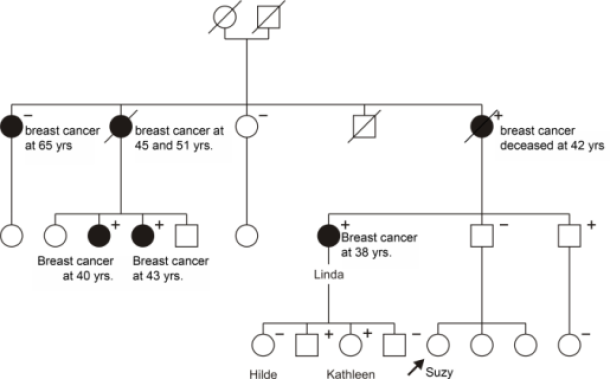
Figure. Example of a family tree of a family with a hereditary predisposition to breast cancer. To protect privacy and anonymity, this family tree is fictitious, but based on experiences from clinical practice. Men are represented by a square, women by a circle. Women who developed breast or ovarian cancer are coloured black. A diagonal line through the symbol means that the person has died.
In this family, many women from different generations developed breast cancer at a young age. The chance that heredity plays an important role is therefore high. In Linda, an abnormality in the BRCA1 gene was found. Further testing showed carrier status (marked with a '+') in several other relatives: in women who had already had breast cancer (diagnostic testing) and in unaffected people (presymptomatic testing), both men and women. In a number of relatives, the mutation turned out to be absent; they are marked with a '-'. The oldest sister of Linda's mother developed breast cancer at the age of 65, but turned out not to be a carrier of the BRCA1 mutation. She is what is called a phenocopy.
During the consultation, Els hears that there is a high chance that heredity plays a role in the breast cancer in her family, and that genetic testing certainly seems worthwhile. She is somewhat surprised that blood is not taken from her straight away. The doctor explains that testing in a family is first done in someone who has had breast cancer, because the chance of finding a mutation is greatest in those people. Els had already talked to her aunt Linda about genetic testing and knows that Linda is very positive about it. Together with Linda, she makes an appointment at the genetics outpatient clinic, so that testing can start with Linda.
At that appointment, Linda receives a detailed explanation of the how and why of genetic testing, and time is also taken to discuss her motivation. Linda finds it acceptable that her niece Els is asking for her cooperation: she had already thought about it herself. She also talks openly about it with her children. She does, however, worry about the possible consequences of an unfavourable result. She finds the idea that her children may also have inherited the predisposition particularly difficult. In addition, her oldest daughter Hilde has already been through a severe period of depression, so genetic testing is not a straightforward matter for her.
Before blood is taken, Linda signs a form in which she declares that she has been sufficiently informed about what the test involves and what the possible results may mean. She is somewhat surprised that the test will take a few weeks, but when the doctor explains the molecular testing, she understands why.
A few weeks later, Linda receives a letter: the testing has been completed and she is expected at the clinic to discuss the result. Els and her aunt go together. They hear that, as expected, an abnormality or mutation has been found in the BRCA1 gene. Linda had already discussed the possibility of being a carrier with her oncologist. She had decided that, if she did turn out to be a carrier, she would have her ovaries removed preventively. A preventive removal of the breast frightens her too much, although the fear of a new breast tumour naturally remains. She chooses to be closely monitored and so to keep the risk as small as possible.
Els expects that blood will now be taken from her straight away: after all, it can be checked whether she is a carrier too. But the doctor explains that it is better to test her father first. Her father has a 50% chance of being a carrier. If he has not inherited the mutation, his children do not need to be tested. Els is somewhat disappointed, but the thought that her father may not be a carrier reassures her. She is also glad that the test for her father will take much less time: now that the mutation in the BRCA1 gene is known, it can be determined much more quickly whether someone is a carrier. After only about four weeks, her father gets an appointment to discuss his result. He turns out not to be a carrier. Els is extremely happy. It means that she and her sisters cannot have inherited the BRCA1 mutation, and that their risk of breast cancer is no higher than that of other women of their age. Els decides to take part in population screening with mammography from the age of 50.
Linda's oldest daughter Hilde does not know whether she wants to have the test. She doubts whether she could cope with a bad result and decides to wait a while longer. Linda's younger daughter Kathleen does want to have the test. She makes an appointment at the outpatient clinic and receives information there about the different aspects of the testing. She also talks to a psychologist about the reasons why she wants the test, and about how the result may affect the rest of her life. Kathleen says that if she is a carrier, she will have a preventive mastectomy with immediate reconstruction. She is not considering having her ovaries removed straight away, mainly because she is still so young. The risk of breast cancer worries her more: she has seen up close how her mother was ill and had chemotherapy, and she wants to avoid that at all costs. Her children also play an important role in her decision: Kathleen wants to always be there for them and therefore wants to make the chance that she will ever become ill as small as possible.
After four weeks, Kathleen returns to the outpatient clinic for her result. She turns out to have inherited her mother's mutation. After an initial period of intense emotions, she fairly quickly finds a certain balance. She draws strength above all from knowing where she stands. It also reassures her that she can always turn to the doctor and the psychologist at the outpatient clinic if she needs more medical information or if the result proves harder to bear.
In the months that follow, there is a lot of talk in the family about genetic testing. Some do not want to have the test. Others, both men and women, want certainty and make an appointment. Hilde, too, eventually takes the step. After the test, she turns out not to be a carrier. She is enormously relieved, but still feels somewhat guilty towards her sister.
Read also
You can find an overview of other risk factors on Breast cancer risk factors. You can read more about screening and self-examination on Screening and breast self-examination. Would you like to talk about the impact of a hereditary predisposition? Then also read our page on psychology.